
Seven steps for planning for the next normal in professional and continuing education
September 2020
DOWNLOAD ARTICLE
Six months into COVID-19, it’s time for administrators and faculty to proactively address how their professional and continuing education programs will compete on value in order to survive and flourish in the post-pandemic “next normal.”
HIGHER ED’S NEXT NORMAL
COVID-19 is accelerating a disruption in higher education, which will disproportionately affect certain categories of colleges and universities.
Of the nation’s 1,550 baccalaureate, master’s and doctoral institutions, a majority are dependent on tuition income for 40% or more of their operating revenues.
Before COVID-19, these market-sensitive institutions already faced significant challenges from projected demographic declines in traditional-aged undergraduates, expansion of online competitors, and shifts in marketplace attitudes about the value of conventional degrees. Lacking large endowments or alternative revenue sources, these schools have less financial cushion or reserves to withstand and recover from the pandemic.
Some experts predict that as many as a quarter of market-sensitive institutions will fail, merge, or be acquired post-COVID-19. In an August Sector Comment on higher education, Moody’s anticipates that the pandemic will be “highly disruptive over the next one to two years,” and will “expedite existential threats” for institutions that are unable or unwilling to “accelerate business model transformation” to account for expansion in online and hybrid learning and alternative credentialing.
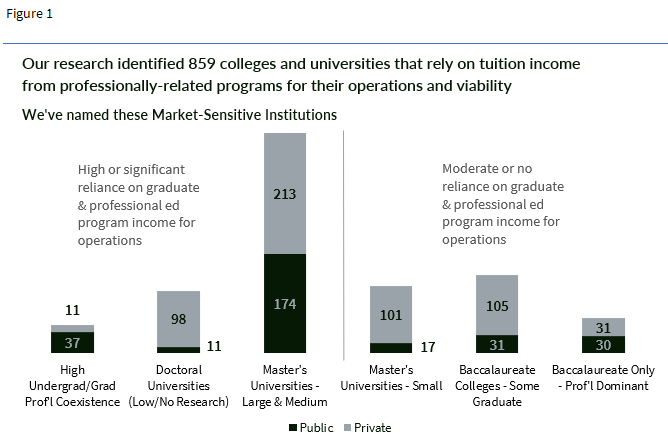
The largest groupings of market-sensitive institutions are medium- and large-master’s and doctoral universities that count on graduate and professional education program income to balance their budgets. (See figure 1.) Any significant losses in these program revenues will further exacerbate their operations and viability.
Winners and losers will quickly emerge in graduate, professional, and continuing education.
We believe that the winners will have superior capabilities to compete on relevant and exceptional value.
COMPETING ON VALUE
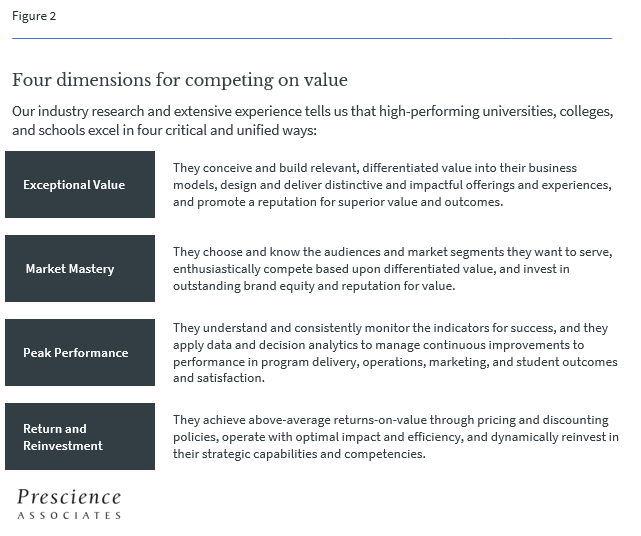
We conducted extensive research into how business enterprises succeed in highly competitive industries and market environments. Based upon this and our 25-years’ experience in higher education, we distill value-based competition into four critical domains:
- Exceptional Value,
- Market Mastery,
- Peak Performance, and
- Return and Reinvestment.
Figure 2 explains each dimension in greater detail.
Professional and continuing education programs that coherently design and manage their business models across these four dimensions have the greatest likelihood of surviving and thriving.
SEVEN STEPS TO INITIATE THIS FALL
Since COVID-19’s onset, professional and continuing education program administrators and faculty have had to focus on how to finish the last academic year and how to safely reopen this fall.
However, six months into COVID-19, they need to become proactive and decisive about what lies ahead in higher education’s “Next Normal.” Here are seven steps to initiate the planning process and reorient their professional and continuing education programs to successfully compete on value in a post-pandemic era.
1. Share and celebrate lessons learned
From its onset, professional and continuing education programs across the nation had to act quickly in response to the COVID-19 spread—creatively making decisions under extraordinary circumstances.
Program administrators and faculty should take an institutional moment to assess internally how they responded to the COVID-19 crisis, share “lessons learned” that can inform post-pandemic planning, and publicly celebrate their achievements and resilience.
Here are some questions that can guide these reflections:
- What capabilities did we marshal or innovate around instructional delivery, student engagement, experiential learning and application, or other activities that hold promise for enhancing or extending the educational value of our professional and continuing education programs?
- On the flip side, what capabilities did we deem essential pre-COVID-19, but may no longer be core to our business model in a post-pandemic environment?
- What activities and interventions did we implement—and succeed with—that can be “bundled” into emergent strategies for business planning?
- Who stepped forward as leaders and innovators during the COVID-19 response—and can envision and guide post-pandemic planning?
The fall semester is also a good time to survey students, faculty, educational partners, and other constituencies about their satisfaction with the university’s COVID-19 management, interventions, and communications; to learn about changes in their post-pandemic needs, expectations, and constraints; and to assess their loyalty.
2. Delineate future forces
The pandemic influences near-term planning for professional and continuing education in two ways:
- Certain disruptive forces will accelerate, as we are already seeing with the rapid deployment of online and hybrid learning, alternative credentialing, working remotely, virtual student recruitment, and the like.
- Other trends that were in motion will likely decelerate or reverse, such as internationalization in student enrollments and study abroad.
Program administrators and faculty can begin scanning and assembling the most critical forces and trends that are expected to influence both near-term and strategic educational value and competitive performance, in the professional areas and industries targeted by their programs as well as across postsecondary education.
Formal scenario planning methods can be applied where there is uncertainty about the directions or impacts of major trends and future forces. See our related article, “COVID-19: Using Scenario Planning to Prepare for an Uncertain Future.”
3. Inventory and assess capabilities
Sustained success in competing on exceptional value derives, in large measure, on the distinctive, differentiating, or leading capabilities that a professional school or continuing education division can acquire and develop.
A major event like COVID-19 interrupts the continuity of competitive dynamics in two major ways:
- Disastrous effects. Once the pandemic is remediated or controlled, we can expect that certain effects—say, the mandate for social distancing—will be relaxed or reversed, and conditions will be reestablished or rebuilt much like they were before COVID-19.
- Disruptive effects. Certain consequences of the pandemic will have lasting effects because they will endure into the next normal or they will accelerate or stimulate new ways for designing, creating, and delivering value.
Program administrators and faculty can inventory the capabilities inherent in their pre-pandemic business model, as well as identify new capabilities they discovered or innovated in immediate responses to COVID-19. They can then assess which capabilities will continue to contribute to post-pandemic educational value, which should be modified or realigned, and which are no longer relevant and should be de-invested.
4. Know the competition
Market-sensitive universities, including their professional schools and continuing education divisions, will win or lose in the next normal primarily against institutions in shared competitive ecosystems.
Administrators and faculty will want to refresh their knowledge about individual competitors and competitor sets by conducting “deep-dive” research into their: program portfolio mix; overlapping market segments; performance trends; program, curriculum, and delivery design; faculty and other resources; pricing and discounting; brand and reputational positioning; recruitment outreach; and differentiating characteristics.
A thorough competitive research effort draws and assembles information from a variety of sources: public databases (e.g., IPEDS); academic and industry rankings; accrediting and professional association resources; competitors’ own reporting; and intelligence extracted from competitors’ websites. The research should also investigate how competitors are responding to COVID-19, what strengths and weaknesses their responses reveal, and what directions they might follow post-pandemic.
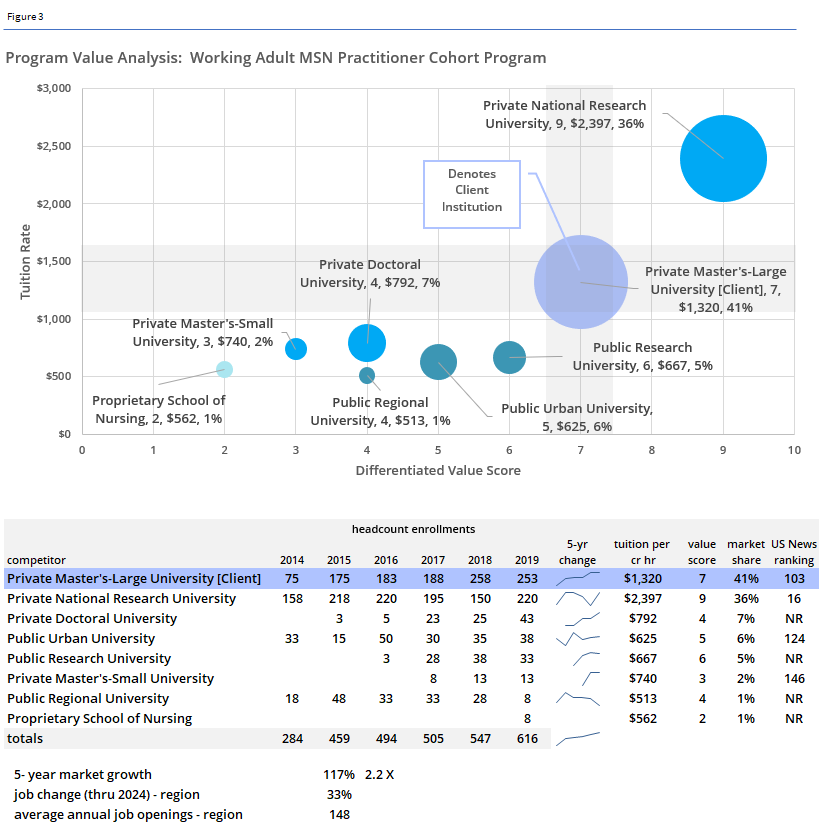
In working with academic enterprises, we have found it valuable to visualize competitive positioning through a Program Value Analysis dashboard (see figure 3 for a snapshot). The sample Value Analysis summarizes enrollment size, market share, and tuition costs for each competitor program (in this case, an MSN-degree cohort program aimed at full-time working professionals). The Analysis uses weighted scoring techniques to assign a “value score” (from 1 to 10) to our client and competitor programs.
The sample Value Analysis shows our client university’s strong share in a growing regional market for MSN degrees for working adults, well positioned on price. The program should follow a competitive strategy of “focused differentiation,” in order to selectively improve its value through targeted investments. This strategy would protect it from the cluster of institutions that are trying to compete on price (but at lower value), while co-existing with a national research university that can afford broader value differentiation (at a higher price).
5. Refine the business model
A coherent business model for academic enterprises answers four fundamental questions:
- Where will we play? What industry and market segments do we choose to target? What are each segment’s functional requirements, affective and motivational needs, and constraints and barriers, against which exceptional educational value is designed? And, as important, where do we choose not to play, because we cannot compete on exceptional value?
- How will we play? What are the ruling competitive dynamics for our targeted industry and market segments? What is an optimal mix of programs and delivery options? What channels, relationships, and partnerships are critical to carry out our programs? What capabilities, resources, assets, and organization are necessary to effectively compete on value?
- How will we win? What is our “winning aspiration” or overarching purpose? Will we win through price leadership, broad differentiation, or focused differentiation? What capabilities, strategies, activities, and management systems are essential for winning the confidence and loyalty of our targeted audiences?
- How will we recapture and reinvest value? What are the combined pricing and discounting policies, cost structure, and performance and efficiency strategies that ensure sufficient recapture of net revenues? How will we reinvest in critical capabilities and activities to sustain competitive advantage? Where will we seek improved operating efficiencies or de-invest in underperforming programs and activities?
COVID-19 is accelerating trends and future forces that were already in play, as well as adding new disruptions to higher education in general and professional and continuing education programs specifically. Market-sensitive educational enterprises will want to reexamine and refine their business models accordingly, in order to remain competitive.
The business model canvas is a popular tool for synthesizing and visualizing the business-model creation process, as well as applying scenario planning to generate and evaluate alternative business models. We have created a downloadable Academic Value Model Canvas that we regularly use in planning for academic enterprises.
6. Expand data analytics and modeling
The capability to apply data analytics and modeling to decision making and performance management is rapidly becoming a competitive competency for the post-pandemic era.
Administrators and faculty are typically familiar with reporting analytics and descriptive analytics, for instance to monitor spending-against-budget or to track headcount, credit hour, and revenue trends.
Three additional types of data analytics are becoming increasingly essential:
- Diagnostic analytics, which move beyond determining what is happening (descriptive analytics) to investigating why is it happening? Interactive drillable dashboards and data visualization techniques such as decomposition trees help explore key attributes or influencers in performance, for example among student and market segments. Advanced techniques such as Activity Based Costing (ABC) and Market Life-Cycle Analyses provide more comprehensive and insightful views than traditional academic program review methodologies.
- Predictive Analytics has taken center stage in national and international tracking and forecasting of COVID-19. It is equally important that academic administrators strengthen their predictive analytics and modeling capabilities, to build alternative business scenarios for an uncertain future; forecast performance outcomes under current momentum or under a new strategic or business direction; anticipate and know the consequences of critical decisions made in “real time”; and adjust budgeting and resource allocation in light of current and expected realities.
- Prescriptive Analytics apply business rules and advanced statistical and analytical techniques to “prescribe” an optimal course of action. For instance, “back-solver” tools can help determine the best mix of programs and markets for optimal revenue generation, given constraints around faculty resources, pricing and discounting, market size and availability, and marketing and recruitment resources. Monte Carlo techniques can help manage acceptable risk for program expansion and development against potential return on investments.
Program administrators should familiarize themselves with the full scope of data analytics and modeling tools available to them—both from their internal institutional research functions and from external specialists—and craft an agenda for incorporating them into research, performance management, and planning and decision making
7. Baseline the brand
As audiences become more sensitive to return-on-value, market-sensitive universities will need to attend not only to their corporate brands—which have been the focus for most academic brand strategies and communications—but also on the reputations, brands, and brand extensions of their professional and continuing education programs.
The first step in brand building is to take a snapshot of current program visibility, audience perceptions, and brand performance and to determine a baseline on which brand strategy can be built and against which brand investments and performance can be measured and managed.
Besides documenting the current health of an academic enterprise’s brand, a brand baseline study can achieve three additional critical actionable outcomes.
First, by cross-referencing the importance of certain brand characteristics, reputational cues, personality traits, messages, and positioning language against audiences’ perceptions of their performance, the study can help determine:
- Where professional and continuing education programs need to improve their operational performance to strengthen their students’ and constituencies’ satisfaction.
- Where programs should invest in brand and reputational promotion, on brand elements important to constituencies but which are rated low in terms of awareness or communications.
- Where programs should invest in brand evangelization for elements that have the potential for differentiating value but rank lower in importance to its constituencies.
- Where programs should target brand messaging on elements that are important to an audience segment (but not to the population as a whole).
- What brand or reputational elements should be deemphasized or eliminated, because they are not important to constituencies and offer low potential for value differentiation.
Second, in conjunction with refining the business model for professional and continuing education, brand baseline research can test audiences’ receptivity to possible post-pandemic initiatives (for instance, expanded hybrid programming or adopting alternative credentialing); their expected effects on satisfaction and reputation; specific messaging to promote those initiatives; and needs for changing the overall brand composition or adding brand extensions to accommodate or spotlight value initiatives.
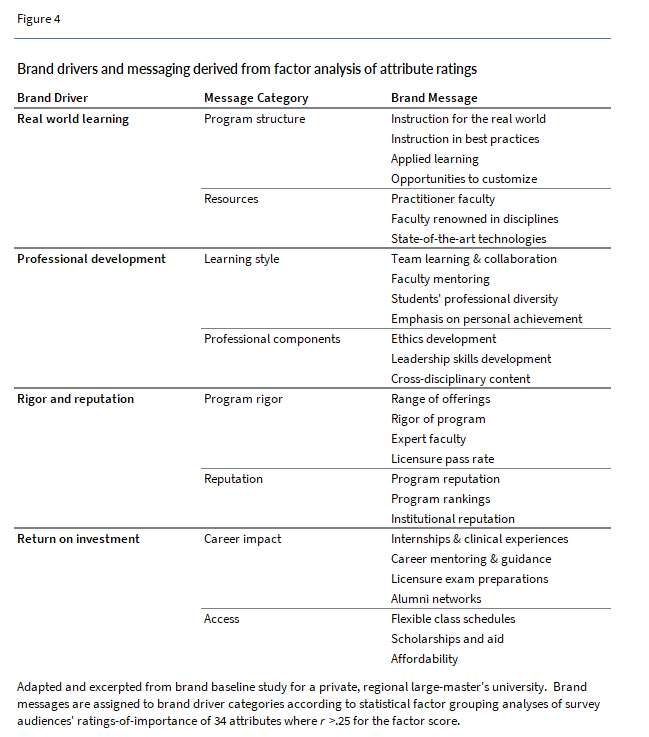
Third, applying certain statistical techniques to a well-constructed brand study can immediately advance the development of a brand messaging system and segmentation schema to target student, employer, and other constituency audiences. Figure 4 is an abbreviated excerpt from a brand baseline study we conducted for a school of professional studies at a private regional large-master’s university. It shows the results of applying factor-grouping statistical techniques to ratings of importance of various brand messaging and promotions.
The client used these results in two ways. First, the consolidation of individual brand characteristics, messages, personality traits, and positioning language guided the conceptualization of the school’s brand platform. The platform included a set of overarching brand “pillars” or themes, as well as a messaging system constructed according to pillars and sub-themes. The formal brand platform in turn accelerated and disciplined the editorial, tagline, and creative process development for the school’s brand.
Second, the client university used these results in constructing a student market segmentation schema based not only on demographic and academic characteristics, but also on affective attributes related to the brand. In turn, a vivid brand persona was created for each segment to inform marketing and communication outreach and authentic recruitment interactions.
CLOSING OBSERVATIONS
Professional and continuing education programs will win in the next normal by acting decisively to harness COVID-19 disruptions to their advantage and to strengthen their capabilities to compete on value.
By starting planning preparations now, administrators and faculty can get a head start on their competitors in understanding emerging opportunities, refining their business model, crafting value-related strategy, and using research and decision analytics for competitive advantage.
DOWNLOAD ARTICLE
About the author
Ronald A. Wendeln, Ph.D. is the managing principal of Prescience Associates. He has more than 40 years of experience in higher education as a faculty member, senior administrator, and national consultant, with expertise in strategic, business, and brand planning and performance management.
Photo by Scott Webb on Unsplash

a
Pepper Pike, OH
216.233.2980
© 2026 Prescience Associates, LLC
Pepper Pike, OH
216.233.2980
© 2026 Prescience Associates, LLC